"Fixing Broken Systems": Desiree Dickerson on Why Skill Gaming is the US Market’s Trojan Horse
 By Liam O'Brien · Contributor3 min read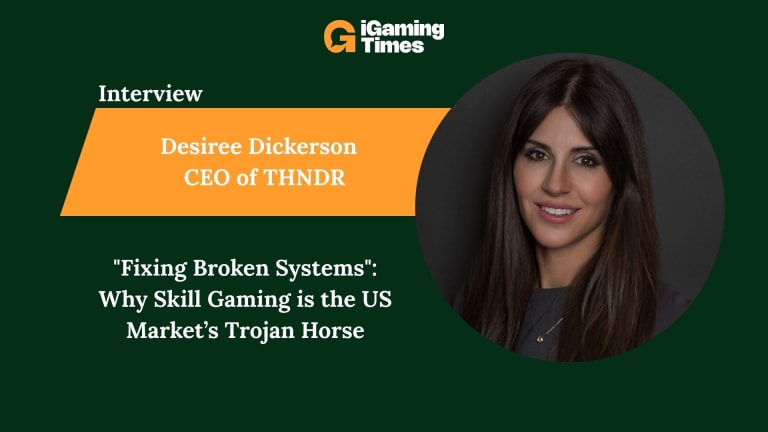
Now, she is applying that same "fix-it" philosophy to the gambling industry. Her target? The historical graveyard of Peer-to-Peer (P2P) betting.
By solving the liquidity problem that has plagued previous attempts and removing the "[House Edge](/glossary/house-edge)," THNDR is positioning itself as a critical entry point for the US market. We sat down with Desiree to discuss why skill gaming is the answer to the current sweepstakes uncertainty and why CFOs love a product with zero volatility.
The Commercial Argument: Zero Volatility
iGaming Times: THNDR’s pitch involves "eliminating the house." For a traditional casino CFO addicted to the mathematical certainty of the House Edge, what is the commercial argument for integrating a P2P product?
Desiree Dickerson: Eliminating the house benefits both the user and the operator. In a PvP model, operators earn guaranteed, margin-positive fees on every wager without taking gameplay risk or managing RTP. It becomes a pure volume business: casino-level engagement with sportsbook-style economics.
For a CFO, that means predictable margins, zero volatility, and revenue that scales directly with throughput instead of probability.
Beyond the economics of the wager itself, we help operators monetise the empty spaces in the customer journey. Our games fill natural downtime, like halftime, off-season, and gaps between bets. We convert what was previously zero-revenue dead time into engagement and spend.
iGaming Times: You highlight that skill games allow entry into blocked markets. Where are you seeing the most traction with this "regulatory arbitrage"?
Desiree Dickerson: We are seeing the most momentum in the U.S., where operators want to offer iCasino-like experiences but cannot touch iCasino regulation. Skill games give them legal and compliant access into those markets.
We are also seeing interest from offshore operators who view skill as a fast, low-friction way to establish a U.S. footprint. In many ways, skill gaming has become the entry point for jurisdictions that are restrictive today.
iGaming Times: With games like Skill Slots and Bingo, the line between skill and chance can blur. How do you technically ensure these remain classified as "skill-based"?
Desiree Dickerson: We build every game around a simple and legally defensible foundation: both players receive identical starting conditions. In practice, both players receive the same shuffle, seed, deal, or reel sequence. This removes chance as a deciding factor and shifts the outcome entirely to strategy, execution, and skill.

To further validate this, we run large-scale skill analyses across tens to hundreds of thousands of rounds to quantify how strongly player decisions drive match outcomes. That empirical data is incorporated directly into our legal opinions.
Solving the Liquidity Trap
iGaming Times: The history of P2P betting is filled with companies that failed due to empty lobbies. How does your infrastructure achieve a 99.9% fill rate where others failed?
Desiree Dickerson: The biggest hurdle in player-vs-player constructs is player liquidity, or ensuring there is an opponent for every match a user enters. Most companies tried to build walled gardens with single-operator pools or single-game ecosystems. But this inevitably fails under the weight of empty lobbies.
We solved this with our cross-operator matchmaking network, which serves as a [shared liquidity](/glossary/shared-liquidity) layer across our operators. When a player initiates a match on Operator A, the system queries availability across the entire network, finds an opponent with a compatible skill profile, and matches the two users. It is essentially a real-time player exchange. The result is a self-reinforcing network effect. Every new partner increases liquidity for the entire ecosystem.
iGaming Times: You recently went live on the Elantil Marketplace. Does this signal a shift in your distribution strategy?
Desiree Dickerson: We are a startup, so we are exploring every distribution channel that gets our product to players and operators as quickly as possible. While our initial focus was on direct integrations, partnering with Elantil gives us accelerated access to high-quality operators and the opportunity to collaborate with one of the most forward-thinking teams in the industry. This is a strategic expansion of our distribution strategy to reach Tier 1s faster and more efficiently.
Player Psychology & Retention
iGaming Times: Traditional slots are a passive experience. Do you find that your games cannibalise the time-on-device of traditional slot players?
Desiree Dickerson: We actually see the opposite of cannibalisation. We experience new engagement from an underserved segment within some operator user bases.
Our games appeal to players who want a quick dose of head-to-head competition during moments when traditional content struggles to hold attention, like halftime or between slot sessions. Instead of pulling players away from slots or a sportsbook, we fill the engagement gaps the casino lobby or sportsbook homescreen do not currently serve.
We do see more Gen Z and video game users interacting with our games. Those userbases are turned off by playing against the house, so they are more likely to engage in PvP, skill-based competition.
iGaming Times: How are you using social mechanics to create the "sticky" community effect that sportsbooks often lack?
Desiree Dickerson: Speed is always nice, but real stickiness comes from fair and balanced competition. Our matchmaking algorithm ensures players are paired with someone of a similar skill level. This protects new players from being thrown to the sharks and gives everyone a genuine chance to win, which is a better gaming experience for everyone.
On top of that foundation, we introduced leaderboards, round replays, and player stats that give users something to chase beyond a single round. In the next month or so we are rolling out recurring tournaments that create even more social engagement, keeping users coming back for bigger prizes.
Leadership & Vision
iGaming Times: Your career path spans the Department of Veterans Affairs, blockchain in Rwanda, and now iGaming. Is there a common philosophy that ties these together?
Desiree Dickerson: To be honest, at first thought I would say there is really no common thread tying my academic or professional experiences together outside of working on problems I find interesting.
But diving a bit deeper, I love fixing broken systems. At the VA, it was improving outdated tech organisations. In Rwanda, it was empowering women with financial tools they never had access to before. And in iGaming, it is about modernising how people compete and how operators engage and monetise those users. The industries are different, but the challenge is the same. It is all about finding inefficiencies, removing friction, and building systems that give people better outcomes.
iGaming Times: Looking at 2026, where does "Skill Gaming" go from here?
Desiree Dickerson: Skill gaming is only at the beginning of its growth curve. Next year, with the continued sweeps uncertainty and the normalisation of prediction markets, operators will be looking for compliant, high-engagement alternatives. Skill gaming naturally fills that gap, and we are focused on making THNDR the face of that movement. And we will.