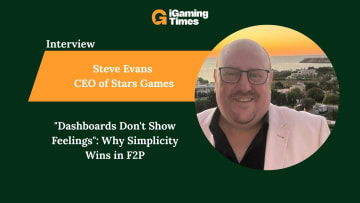
WiseGaming's Steven Paton: Technology, Not Geography, Decides Who Survives
 By Antonina Tupikova · Founder, iGaming Times8 min read
Every analyst note leads with Brazil, Africa or the next US state. WiseGaming's commercial director says market access without a stack that can localise in weeks is "a money pit", that Curaçao's LOK reform is a filter he welcomes, that the agent model is converting rather than dying, and that his platform charges on net profit after bonuses, PSP and content costs rather than on GGR. He also says where the whole industry, his company included, is still behind on AI.
- Steven Paton, Commercial Director at WiseGaming, argues that the next phase of iGaming growth will be led by technology rather than geography, and that operators who win expensive local licences "bleed market share" when a monolithic stack takes six months to add local payments or scale for peak events
- WiseGaming, which operates under a Curaçao licence in the new LOK framework and runs its own B2C brands on the same infrastructure, targets agent-based operators across Latin America, Africa and Asia and says the agent model is "converting into a digitally managed, structured network" rather than disappearing
- Its commercial differentiation, Paton says, is deployment in four to six weeks and platform fees calculated "only after bonus deductions, PSP and game provider costs are cleared", on net profitability rather than gross gaming revenue
- The sportsbook is a hybrid: tier-one institutional data and trading feeds for primary coverage, with in-house risk parameters, localised margin management and liability controls; AI is "commercially material" in CRM orchestration with Symplify and predictive risk monitoring, and the industry is "still maturing" on autonomous front-end generation and voice customer service
- Five years out he sees WiseGaming as "a leading tier-one challenger to legacy providers" in the high-growth segment, and says mid-tier platforms get consolidated when they "try to mimic legacy monoliths"
A Platform Executive Who Has Sat in Every Other Seat
The platform business sells the same promise to every operator: speed, scale and a wider product menu than the last vendor. What is rarer is a platform executive who has been the customer. Steven Paton's career runs through affiliate tracking at NetRefer, content at Pragmatic Play, AI customer service at BMIT, slots at AvatarUX and the operator side at Soft2Bet before WiseGaming, where he is Commercial Director. The company he now sells for operates under a Curaçao licence in the reformed LOK framework, runs its own consumer brands on the platform it supplies, and targets agent-based operators in Latin America, Africa and Asia, the markets where regulation is tightening fastest and where the white-label and agent models it depends on are under the most scrutiny.
His thesis is that the industry is looking in the wrong place. Growth, he argues, will be decided by technology rather than by which market opens next, because a licence in Brazil is worth little to an operator whose architecture cannot add a payment corridor or absorb a launch-week surge without a rewrite. That is a contrarian position in a year when every note leads with Brazil, Africa and the American states, and we put it to him directly, along with the harder questions his own pitch invites: what a Curaçao base is worth after the reform, how a white-label offering survives a regulatory climate that has pushed the model out of Britain, whether "platform agility" is anything more than local feature engineering, and which of SoftSwiss, EveryMatrix, BetConstruct and GR8 Tech he actually fears.
Some of his answers are the ones a commercial director is paid to give. Others are not: that the industry, WiseGaming included, is behind on the AI it advertises; that what breaks first at ten-times growth is the integration layer, not the database; that the mid-tier platforms which get consolidated are the ones that try to become the monoliths they compete with. His account of the company's commercial model, fees charged on net profit after bonuses, payment and content costs rather than on GGR, is the claim operators will want to test.
We put 14 questions to Paton, on his career, the technology thesis, mature markets, agents, Curaçao, white label, competition, sportsbook, AI, scale and the five-year view. His answers are reproduced in full below, edited only for spelling and punctuation.
On the Career and the Thesis
Your career has spanned NetRefer in affiliate tracking, Pragmatic Play in content, BMIT in AI customer service, AvatarUX in slots, Soft2Bet on the operator side, and now WiseGaming on platform. What does that breadth actually let you see about how the platform business has changed, and what part of the industry do you think you understand better than someone who has spent the same years inside one company?
Sitting across every seat in the iGaming value chain, from affiliates at NetRefer, tier-one suppliers at Pragmatic Play and AvatarUX, AI infrastructure at BMIT, to operator P&Ls at Soft2Bet, gives me an authentic reality check. Single-track platform veterans often treat platforms purely as code delivery. Having managed actual operator balance sheets, I see the platform as the connective nervous system of a business, where hidden friction can silently drain margins.
What I understand better than single-company veterans is the true operational cost of technical debt and integration latency. I know how studio monetisation actually works, how rigid affiliate attribution can bleed revenue, and how live B2C teams operate under pressure. Today, platforms aren't static feature repositories; they are agility engines. My multi-angle perspective ensures we design platform architecture that eliminates operational drag and directly protects operator profitability.
Your thesis is that the next phase of iGaming growth will be led by technology, not geography. That is contrarian in an industry where every analyst note still leads with Brazil, Africa or US state expansion. Make the case: where is the evidence that tech is the binding constraint rather than market access?
Market access without technical scalability is a money pit. Analysts highlight geographic expansion, but opening a new market means nothing if your legacy stack cannot localise at speed or handle regional traffic surges. We see operators secure expensive local licences only to bleed market share because their rigid monolithic architecture takes six months to integrate local payment corridors, adapt to native UX preferences, or scale during peak events.
Geography is simply the battleground; technology dictates who survives. The binding constraint isn't getting into Brazil or LatAm. It is maintaining low-latency performance, deploying hyper-personalised player journeys, and executing launch rollouts in weeks rather than months. Operators using flexible, API-first architecture consistently outpace incumbents burdened by technical debt. Winning the next phase of growth won't belong to who plants a flag first, but to who scales cleanest.
On Mature Markets
EU markets are mature, expensive to enter and dominated by incumbents in most verticals. What technology actually moves the needle for an operator competing in the UK, Spain, Italy or Sweden today, when the practical levers tend to be pricing, brand, retention spend and channel?
In mature EU markets, technology doesn't replace traditional levers like brand or retention spend; it optimises their ROI. When customer acquisition costs are at record highs, the technology that moves the needle is real-time orchestration and predictive personalisation.
If a player lands on your site and faces clunky navigation, slow odds updates, or generic game lobbies, your expensive acquisition campaign is wasted. Advanced technology allows operators to dynamically personalise player journeys, tailor bonus mechanics via AI-driven CRM integrations, and execute instant payouts that build immediate trust. Furthermore, a high-performance, elastic cloud infrastructure drastically lowers operational overhead, allowing operators to redirect spend towards higher retention or sharper pricing margins. In saturated European markets, technology is the efficiency engine that converts raw marketing spend into sustainable player lifetime value and protected operating margins.
On Agents, Curaçao and White Label
WiseGaming targets agent-based operators across LatAm, Africa and Asia. The agent model has historically been concentrated where regulation is light, opaque, or both. As regulation tightens in those regions, how viable is that customer base in three years, and what is your platform's path to serving fully regulated operators in those markets?
The agent model remains highly viable because it solves a fundamental structural challenge: localised distribution, trust, and physical cash liquidity where banking penetration is low. It isn't disappearing; it is converting into a digitally managed, structured network.
Our platform supports this evolution by providing operators with granular backend controls, automated sub-agent credit management, and real-time transaction visibility. This gives agent networks the operational structure needed to scale cleanly across grey and emerging markets without losing their localised reach. As these regions mature, the path forward isn't abandoning the model, but empowering operators with transparent financial reporting and flexible platform tools. In three years, the dominant agent networks will be those backed by software that bridges traditional localised agent hierarchies with modern, scalable digital infrastructure.
WiseGaming operates under a Curaçao licence in the new LOK framework. The reform is materially squeezing operators and platforms, with rising compliance costs and tighter scrutiny. What does the new Curaçao reality mean for WiseGaming's commercial model, and is it still the right base for the business you are building?
The LOK framework acts as a natural commercial filter, raising the baseline for technical substance and operational reliability. Rather than squeezing our business model, it separates professional software providers from under-capitalised vendors who rely on legacy sub-licensing shortcuts.
Curaçao remains the ideal operational base for our strategy. It delivers a recognised, highly flexible framework that supports crypto-native transaction flows and rapid entry into dynamic global markets, without forcing operators into rigid, multi-year localisation deadlocks. Because we operate our own live B2C brands on the platform, our infrastructure already meets high standards for security, uptime, and automated risk management. For WiseGaming and our partners, the new reality simply validates a focus on sustainable, high-performance operations while preserving the speed and commercial agility that emerging market operators require.
White label in iGaming has come under increasing regulatory pressure: the UK Gambling Commission has effectively pushed it out, and Sweden and others are heading the same way. WiseGaming's white label offering is central to its pitch. How are you adapting that model for a future where principal licensee accountability is the norm rather than the exception?
Pressure on white labels stems from legacy platforms acting as passive badge-issuers without real-time operational control over their partners. We approach white label and turnkey partnerships through an active, tech-led model built around centralised operational visibility.
Through a single administrative backend, our platform provides automated risk triggers, centralised player-protection tools, and complete transaction monitoring. While certain mature European jurisdictions favour direct operator licensing, fast-growing markets in LatAm, Asia, and Africa still depend heavily on white-label structures for rapid market access and localised execution. By embedding robust automated controls directly into our platform backend, we ensure our white-label partners gain immediate speed-to-market and operational flexibility, backed by a stable, predictable technical infrastructure that supports their long-term growth.
On Competition and Sportsbook
The platform space is consolidating, with SoftSwiss, BetConstruct, EveryMatrix, GR8 Tech and others fighting for the same operator spend. What is the honest commercial differentiation of WiseGaming beyond a wider product menu, and which of those competitors do you take most seriously?
Our core differentiation combines B2C-proven deployment velocity with an operator-friendly commercial model. Unlike legacy platforms that charge high fees directly on top-line GGR, our platform fees are among the lowest in the industry, and critically, we don't calculate fees on gross GGR. We calculate our fees only after bonus deductions, PSP, and game provider costs are cleared, charging on actual net profitability.
We respect competitors like EveryMatrix for product breadth and SoftSwiss for early crypto adoption. However, we win operator spend on agility and margin protection. Where traditional vendors force partners into rigid roadmaps and heavy top-line revenue cuts, our API-first modular architecture deploys localised setups in four to six weeks. We aren't a slow-moving corporate platform taking unfair margin cuts; we are a lean, high-velocity engine built to maximise operator profitability.
Your sportsbook claims 100 plus sports, 120,000 plus live and pre-match events monthly, 3,000 plus markets. The hard part of sportsbook is not the breadth but the trading quality and risk management on the events that matter. Are you running an in-house trading operation, reselling third party feeds, or running a hybrid, and how does the quality stack up against Kambi, OpenBet or SBTech?
We run a hybrid sportsbook model. We integrate tier-one institutional market data and trading feeds for primary coverage, backed by automated in-house risk parameters, localised margin management, and real-time liability controls.
Providers like Kambi or OpenBet offer premium, highly structured products, but they come with heavy commercial terms, rigid integration frameworks, and limited flexibility for operators in fast-moving emerging markets. Our focus is delivering sharp, localised trading quality with operational control left in the operator's hands. We don't force rigid, one-size-fits-all risk profiling across all jurisdictions. Instead, our platform enables granular control over margins, live limits, and regional event prioritisation, giving operators the exact balance of automated trading stability and commercial flexibility they need to compete against local legacy bookmakers.
On AI and Scale
Every platform talks about AI now. What is WiseGaming actually using AI for in production today, where is it commercially material rather than a slide-deck claim, and where are you genuinely behind?
AI is commercially material for us in two core areas today: real-time CRM orchestration and predictive risk monitoring. Through our strategic partnership with Symplify, we deploy predictive models that analyse player behaviour on the fly to deliver hyper-personalised game lobbies, dynamic bonus triggers, and automated churn prevention. On the backend, machine-learning algorithms flag anomalous betting patterns and account fraud instantly, protecting operator margins without manual delay.
Where the entire industry, including us, is still maturing is fully autonomous, real-time frontend generation and automated voice customer service that truly mirrors human interaction. We avoid over-promising AI simply for the sake of marketing. Our development focus remains strictly on high-ROI operational automation: reducing manual overhead in risk management, optimising player lifetime value, and delivering measurable margin improvements for our platform partners right now.
Infrastructure scalability is on your discussion list, and every platform claims to scale. What actually breaks first when an operator running a turnkey platform suddenly grows ten times in three months in a hot launch market like Brazil, and what does WiseGaming have in place that a smaller competitor does not?
When an operator experiences 10x hyper-growth, it isn't the core database that breaks first; it is the third-party integration layer and synchronous payment and wallet API calls. Sudden traffic spikes cause database lockups, delayed wallet updates, and dropped transactions as external payment corridors and game providers struggle to handle peak concurrent requests.
WiseGaming handles high-velocity scale through a cloud-native, microservices-based architecture with asynchronous transaction processing. Instead of hitting the core database with every single event, our backend uses elastic scaling and intelligent caching layers that absorb sudden traffic surges effortlessly. Crucially, because we run our own live B2C operations on this same infrastructure, our platform is continuously stress-tested under real-world concurrency. Smaller competitors test scale in staging environments; we deliver proven, battle-tested infrastructure built to support rapid operator growth without degradation.
On Consolidation and the Five-Year View
WiseGaming positions itself as fast-growing, but this is also a market where mid-tier platforms get acquired, restructured or quietly squeezed. From your commercial seat, what is the strategic call the company must get right in the next 12 to 18 months that decides whether it joins the consolidators or gets consolidated?
The critical strategic call is maintaining laser focus on modular, high-velocity deployment rather than over-extending into heavy corporate bloat. Mid-tier platforms get squeezed when they try to mimic legacy monoliths, building expensive, rigid in-house tech stacks that drive up overheads while slowing down execution speed.
To remain a market leader rather than a consolidation target, WiseGaming must continue capitalising on our lean, API-first orchestration model. We win by being the most agile, partner-friendly platform in high-growth emerging regions, offering rapid four to six week launches and transparent, net-profit-aligned commercial terms. By keeping our platform modular, integrating best-in-class specialist partners like Symplify and Zenith, and continuously proving our tech through our own B2C brands, we maintain strong operational independence, protected profit margins, and a distinct competitive advantage.
The thesis that geography matters less assumes platform agility is a real moat. But operators in Brazil want PIX-native UX, in Africa they want USSD and mobile money, in Asia they want agent-led credit accounts. That is arguably geography wearing a tech hat. How do you separate genuine tech differentiation from local feature engineering dressed up as innovation?
Local features like PIX, USSD, or agent credit flows aren't core tech innovation; they are essential regional table stakes. The true technical differentiation isn't the local integration itself, but the underlying architecture that allows you to deploy those features in days rather than months.
If a platform must rewrite its core codebase to add a regional payment gateway or adapt a front-end layout for LatAm or Africa, that's legacy technical debt. Genuine tech differentiation is having an API-first, microservices orchestration layer where localised modules, whether payment rails, USSD flows, or agent management tools, plug in cleanly without touching the main engine. Local feature engineering is just configuring the surface layer; platform agility is the engine that makes rapid, multi-region configuration scalable without compromising core stability or performance.
Operators increasingly want a multi-supplier, modular architecture rather than monolithic turnkey solutions. That is unflattering for traditional turnkey providers. How is WiseGaming responding, and is the future of the platform business a thinner orchestration layer rather than a one-stop shop?
The era of the rigid, closed-ecosystem turnkey platform is over. Modern tier-one and growth operators refuse to be held hostage by a single vendor's development roadmap or limited product menu. The future of the platform business is absolutely a high-performance orchestration layer.
WiseGaming was built specifically for this shift. Rather than forcing operators into a monolithic box, we position our platform as a modular orchestration engine. Operators can utilise our full white-label package or cleanly plug in their own proprietary frontends, preferred CRM tools like Symplify, or specialised content aggregators via open APIs. We don't view modularity as a threat to our turnkey business; we view it as our greatest commercial advantage. By giving operators complete autonomy over their tech stack, we deliver the flexibility they demand while maintaining a reliable, high-speed backend infrastructure.
Five years out, where do you actually see WiseGaming: a focused mid-tier platform serving emerging markets and agent-based operators, a Tier 1 challenger to SoftSwiss and EveryMatrix, or absorbed into one of them in the consolidation cycle?
Five years out, I see WiseGaming positioned as a leading tier-one challenger to legacy providers, not by copying their heavy corporate structures, but by establishing a strong position in the high-growth, agile segment of the market.
Consolidation often happens to mid-tier platforms that lack clear technical differentiation and get squeezed by high operating costs and slow execution. Our modular architecture allows us to deploy setups in four to six weeks, while our commercial model directly aligns with operator profitability, giving us a distinct position in the market. We aren't interested in becoming another slow-moving legacy platform. We will continue expanding our footprint across LatAm, Asia, Africa and regulated markets, serving ambitious operators that value speed, flexibility and margin protection. By staying lean, B2C-proven and partner-centric, WiseGaming can lead the next wave of high-velocity platform providers.
The Fee Model Is the Claim to Test
Strip away the vocabulary and Paton's pitch has one sentence in it that an operator can put in a contract: fees calculated after bonuses, payment processing and game-provider costs, on net profitability rather than gross gaming revenue. Every platform says it is agile. Very few say they will let the operator's real margin, not its top line, set what they are paid, because that puts the vendor on the wrong side of every bonus and every PSP fee. If the terms match the description, that is a genuine difference in a market where the standard model is a percentage of GGR. If they come with minimums and floors that reintroduce the top line by another name, it is a slogan. The answer is in the term sheet, not the interview.
Curaçao as a Filter Is a Bet That the Filter Keeps Passing You
Paton's view of the LOK reform, that it separates professional providers from under-capitalised ones, is the right way for a platform to think about it and also the most exposed. A framework that raises the baseline can keep raising it, and the markets WiseGaming targets, Latin America, Africa and Asia, are the ones whose own regulators are least inclined to treat a Curaçao licence as sufficient. The answer to the white-label question, active operational control through a single backend rather than passive badge-issuing, is the right answer for the regulators heading Britain's way. It is also an admission that the model's survival now depends on the platform being able to prove, jurisdiction by jurisdiction, that it is the accountable party. That is a compliance burden dressed as a product feature, and it will grow.
The Honest Answers Are the Useful Ones
Three things in this exchange are not what a commercial director usually says. The industry, WiseGaming included, is behind on the AI it advertises. What breaks at ten-times growth is the integration layer and the synchronous wallet calls, not the database, which is the answer of someone who has watched it happen. And the way a mid-tier platform gets consolidated is by trying to become a monolith, which is as clear a statement of strategy as "we will stay small enough to be fast" gets from a company that also says it intends to be a tier-one challenger. Those two ambitions pull against each other, and the next five years will show which one WiseGaming meant.
Paton's case is that the operator who scales cleanest beats the one who plants the flag first. His company's test is whether a Curaçao-based, white-label, agent-focused platform can keep passing the filters it says it welcomes while staying lean enough to be the challenger it describes.